Epigenetic Reprogramming: "The biggest thing in healthcare in 100 years—Or Ever."
Altos Labs—Part 2 of a mini series on aging and the companies working to cure it.

Hi there beautiful reader! 👋 Sonia here—hope you’re fab 😊
This is Part 2 of my mini series on aging and the companies working to cure it. Read the first post here:
Part 1. Senescence and shit: The 7 causes of aging.
For the rest of the series, consider subscribing 😉
Altos Labs, the best funded biotech startup in history, is tackling aging
There’s something quite amazing happening in the aging research space. People are not only starting to believe that aging is actually something that could be prevented, but we’re finally starting to see huge investment in the startup world.
In 2022, Altos Labs raised $3 billion in seed money—thanks to people like Jeff Bezos Robert Nelson and Yuri Milner—and today they have almost doubled that, with $5.56B raised according to Pitchbook.
This is huge progress. A few decades ago, the study of gerontology (aging) had very little attention, both in academia and industry. But today, people like Rick Klausner and Juan Carlos Izpisua Belmonte, the scientists leading the research at Altos Labs, are paving the way for groundbreaking advancements in cellular rejuvenation that could meaningfully reduce aging and vastly improve human healthspan.
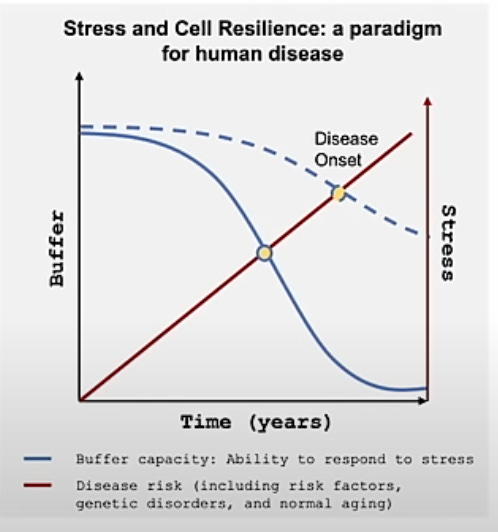
The importance of treating aging as a risk factor
The reason for this increase in funding and research into aging is due to a shift in perspective. Aging is no longer seen as an inevitable process that our bodies must endure. Instead, we understand the causes of aging, and see aging as an underlying risk factor for disease.
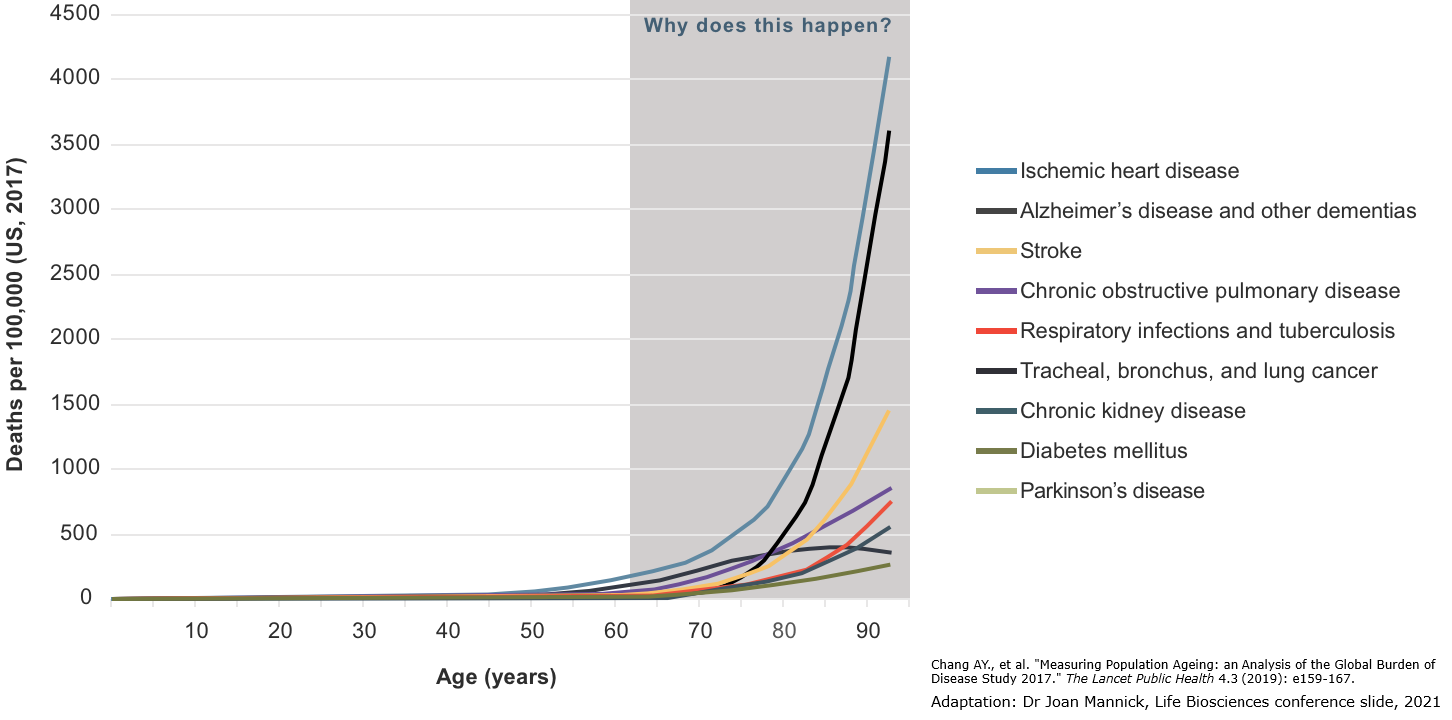
When our cells are young and healthy, they have a high buffer capacity, meaning they are resilient and can deal with the stresses our bodies face.
Over time, due to our cells being exposed to more and more damage, they lose this buffer capacity and become weak and unhealthy cells.
As our cells weaken and their buffer capacity declines, they become less effective at preventing disease.
Juan Carlos Izpisua Belmonte from Altos Labs gave a wonderful talk in 2024 on how this impacts disease onset. As time passes, our cells buffer capacity declines, meaning our risk of disease increases—leading to disease onset.
But can we increase our cells buffer capacity, meaning we could delay or even prevent disease onset?
With epigenetic reprogramming, this might be possible.
What is epigenetic reprogramming?
Epigenetics is how our cells develop into their specific cell types. Skin cells, eye cells, brain cells, etc.—they all have exactly the same DNA, but a different epigenome. Different genes are turned on or off in each of these different types of cells, making them the cells that they are.
Chromatin is the physical packaging of DNA within our cells. Closed chromatin means genes are turned off, while open chromatin means genes are turned on. Epigenetics controls chromatin structure—this is what determines which genes are turned on or off to make different cell types.
Changing if chromatin is closed or open could impact disease onset.
After years of research, we now know that there is a correlation between chromatin, aging and disease. As we age, our chromatin become more open (turned ‘on’) when they shouldn’t be, which leads to age-related diseases like Alzheimer’s, cancer, or diabetes.
If we could alter chromatin to turn off again, and revert to their younger states, this could delay the onset of age-related diseases.
What epigenetic reprogramming could mean for the future of healthcare
So far, epigenetic reprogramming has mostly just been done in mice. There have been studies where human cells have been epigenetically reprogrammed, but only in petri dishes, not in fully functional humans.
But we are progressing with this research quickly. Belmonte’s next goal is to focus on ex vivo epigenetic reprogramming—organ transplants. A vast number of organs donated are discarded as they are not healthy enough. If the work at Altos Labs can epigenetically reprogramme these organs, we can ensure we always have healthy organs available for patients to use, reducing the huge amount of wasted organs and increasing the chances of patient organ adoption.
For epigenetic reprogramming to be done directly in human cells, FDA approval will be needed first. This could several years still, but scientists are optimistic that we will see huge leaps in progress soon.
Robert Nelson, one of the key investors in Altos Labs, says “epigenetic reprogramming is the biggest thing in healthcare in 100 years. Or ever”. And he’s not alone. Those in the scientific community seem optimistic and also agree with him.
João Pedro de Magalhães, Chair of Molecular Biogerontology at the University of Birmingham says:
“I imagine a future where children—even before they are born—are engineered not to age or to be resistant to diseases like Alzheimer's. If you cure aging and people have the mortality of young adults, they could live for thousands of years.”
On that positive note,
Have a fab Sunday :)
Further reading
For This Venture Capitalist, Research on Aging Is Personal; ‘Bob Has a Big Fear of Death’ - WSJ
The Personalized Stem Cells That Could One Day Treat Parkinson’s and Heart Failure- WSJ
Hey! Thanks for being awesome and reading my work!
If you’re interested in weekly articles on the health tech industry, how startups run, or early-mid stage career guidance, please subscribe :)